Processing details
Brainana adapts its pipeline depending on what data and metadata are available and on the configuration you provide. For example, anatomical synthesis runs only when multiple T1w/T2w runs or sessions are present and synthesis is enabled; slice timing correction runs only when slice timing information is available in the BIDS metadata.
This page describes the methods used at each stage of the pipeline and links to related anatomical and space-tracking details.
1. BIDS discovery and job creation
Before the Nextflow workflow runs, a Python discovery step scans the BIDS dataset and produces structured job descriptors.
Purpose: Determine what data are available and which processing branches should run (e.g. whether anatomical synthesis is needed, whether functional runs have slice timing metadata).
Methods: Deterministic layout/metadata scan using BIDS entities and configuration. Discovery evaluates whether anatomical synthesis is needed and decides synthesis type/level (session vs. subject) from config. There are no imaging algorithms at this stage.
2. Anatomical processing
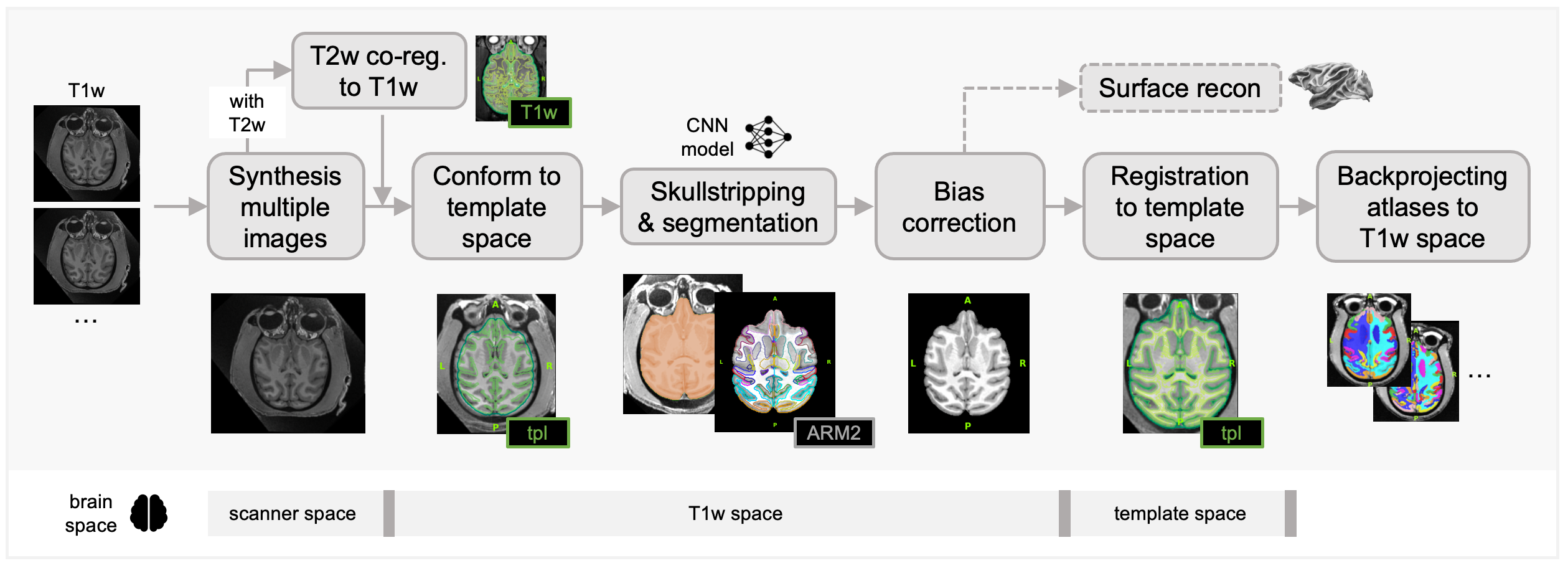
The anatomical branch turns raw (or synthesized) T1w/T2w images into bias-corrected, skull-stripped, and template-registered images, and optionally segmentations and cortical surfaces. These outputs provide the anatomical reference for T2w and functional workflows.
2.1 Anatomical synthesis (multiple T1w/T2w)
When multiple T1w or T2w images exist per session or per subject, Brainana can synthesize a single anatomical reference.
When: Multiple T1w or T2w per session or subject (configurable synthesis level).
Method: The first image (by lexicographic order) is used as the fixed reference. Each other image is rigidly coregistered to the reference using ANTs (
antsRegistrationwith a rigid transform). All coregistered images, including the reference, are averaged in the reference space.
2.2 Conform to reference
Purpose: Align the brain to reference space (orientation and grid) so that subsequent registrations and resamplings are well-defined.
Method:
Skull-strip the input with
nhp_skullstrip_nn(UNet) or use an existing brain mask when skull stripping is disabled.Resample the template to match the input resolution if needed.
Run FSL FLIRT (rigid, 6 DOF) from the brain-extracted input to the template.
Use AFNI
3dresampleto ensure template and input share a consistent grid.Apply the FLIRT transform back to the full-head anatomical.
2.3 Skullstripping and segmentation
Purpose: Provide brain mask and atlas/tissue segmentation for masking, bias correction, registration, and optional surface reconstruction.
Method:
fastsurfer_nn(FastSurfer-style CNN segmentation) is fine-tuned on macaque anatomical MRI with CHARM and SARM level 2 atlases (ARM2 parcellation). The network produces an atlas-labelled segmentation, from which a brain mask and optional hemisphere masks are derived.
2.4 Bias field correction
Purpose: Correct intensity non-uniformity (INU) in anatomical images.
Method: N4 bias field correction (ANTs
N4BiasFieldCorrection) is run on the anatomical image, with the brain mask from segmentation optionally provided to restrict correction to brain tissue.
2.5 Registration to template
Purpose: Map anatomical data to a standard template space (for example, NMT2Sym).
Method: Multi-stage ANTs registration:
Translation → rigid → affine → optional SyN.
Metrics (e.g. mutual information, cross-correlation, Mattes), gradient steps, shrink factors, convergence criteria, and smoothing schedules are configurable.
When GPU resources and FireANTs are available, the SyN stage can be run with FireANTs.
2.6 T2w to T1w coregistration
When T2w data are present, Brainana can coregister T2w to the preprocessed T1w:
Method: ANTs rigid registration from T2w to preprocessed T1w.
2.7 Surface reconstruction
Surface reconstruction is an optional and resource-intensive step.
Purpose: Build cortical surfaces and morphological measures (e.g. thickness, area, curvature).
Inputs: Preprocessed anatomical, segmentation and brain mask.
Method:
fastsurfer_surfreconis a modified version of FastSurfer’srecon_surfpipeline. It orchestrates FreeSurfer volume stages (bias correction, Talairach transform, normalization, WM segmentation) and surface stages (tessellation, smoothing, inflation, topology fixing, atlas parcellation, morphometry).Requirements: A valid FreeSurfer license is required when this step is enabled.
3. Functional processing
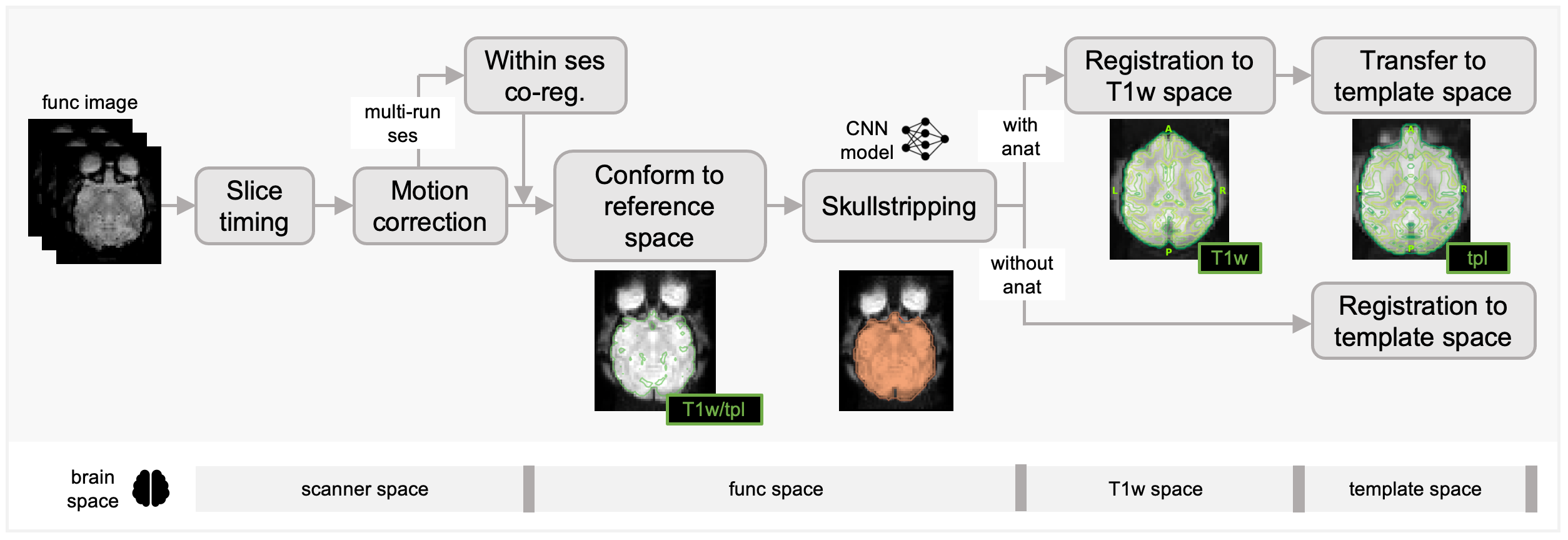
The functional branch preprocesses fMRI data and produces motion-corrected, optionally slice-time-corrected, despiked, bias-corrected, and skullstripped fMRI in native or template space, with associated transforms and QC outputs.
The workflow is conceptually split into:
Time-series steps: Slice timing (if available) → motion correction and temporal mean → within-session coregistration and session-averaged temporal mean.
Compute on temporal mean: Bias correction → conform → brain mask (UNet) → registration to anatomical or template.
Apply to 4D: Apply conform and registration transforms to the 4D fMRI and brain mask.
3.1 Slice timing correction
When slice timing information is available in BIDS metadata, Brainana applies slice timing correction.
Purpose: Align voxel time series in time according to the slice acquisition order.
Method: AFNI
3dTshiftis used to shift slices in time to a reference (typically the middle of the TR). Slice timing pattern (e.g.alt+z,seq+z) is derived from the BIDSSliceTimingandSliceEncodingDirectionfields. If slice encoding is not along the z axis, data are swapped to z for3dTshiftand swapped back afterwards.Control: This step can be disabled in configuration or skipped when slice timing metadata are missing.
3.2 Motion correction
Purpose: Realign fMRI volumes to correct for subject motion.
Method: FSL
mcflirtperforms volume realignment with 6 DOF. The reference volume is either a user-specified timepoint, the middle volume, or a temporal mean (viafslmaths -Tmeanorfslroi). Outputs include motion-corrected 4D fMRI, motion matrices, and motion parameters (TSV).Short runs: For very short runs (e.g. fewer than 15 volumes), motion correction can be skipped, and pass-through outputs (including a temporal mean and zero-filled motion parameters) are generated.
3.3 Within-session coregistration
When multiple fMRI runs exist per session, an optional within-session coregistration step can align runs to a common reference and produce a session-averaged temporal mean.
Purpose: Improve stability of the temporal mean used for bias correction, conform, and registration.
Method: Rigid registration from each run’s temporal mean to a reference run’s temporal mean, using ANTs or FSL FLIRT as configured, followed by applying the transform to the 4D fMRI and mask.
3.6 Bias correction
Purpose: Improve downstream registration by correcting low frequency intensity inhomogeneity in the reference temporal mean fMRI image only. Bias correction is not applied to the full 4D timeseries, preserving the original temporal signal for subsequent analyses.
Method: N4 bias field correction (ANTs
N4BiasFieldCorrection) is applied to the temporal mean of the motion-corrected fMRI. An optional mask can be used, and intensities may be rescaled (e.g. to mean 100) depending on config.
3.7 Conform and skull stripping
Conform: The functional temporal mean is conformed to the chosen template using the same strategy as anatomical conform:
nhp_skullstrip_nnon the mean, FSL FLIRT rigid registration to the template, resampling with AFNI3dresample, and application of the transform (optionally composed with anatomical transforms).Skull stripping: A UNet-based functional skull-stripping model (
nhp_skullstrip_nnEPI model, derived from NHP-BrainExtraction/DeepBet) is run on the temporal mean to obtain a brain mask, which is then applied to the 4D fMRI.
3.8 Registration
Method: ANTs registration (rigid, affine, or SyN as configured) from the mean functional image to the preprocessed anatomical or directly to the template. Composite transforms are applied to the 4D fMRI and brain mask with
antsApplyTransforms(e.g. BSpline interpolation for fMRI).Outputs: Preprocessed fMRI and mask in anatomical or template space, plus motion and other confounds for downstream analysis.
4. Summary table
Domain |
Step |
Main tool / method |
|---|---|---|
Anatomical |
Synthesis |
ANTs rigid + average |
Anatomical |
Reorient |
AFNI 3dresample |
Anatomical |
Conform |
FLIRT + |
Anatomical |
Skull strip & segment |
|
Anatomical |
Bias correction |
ANTs N4BiasFieldCorrection |
Anatomical |
Registration |
ANTs (optional FireANTs for SyN) |
Anatomical |
Surface recon |
|
Functional |
Slice timing |
AFNI 3dTshift |
Functional |
Reorient |
AFNI 3dresample |
Functional |
Motion correction |
FSL mcflirt |
Functional |
Within-session coreg |
ANTs or FLIRT |
Functional |
Bias correction |
ANTs N4BiasFieldCorrection |
Functional |
Conform / skull strip |
FLIRT + |
Functional |
Registration |
ANTs (optional FireANTs for SyN) |
For outputs and directory layout, see Outputs.